
The Great Figures of Cilento
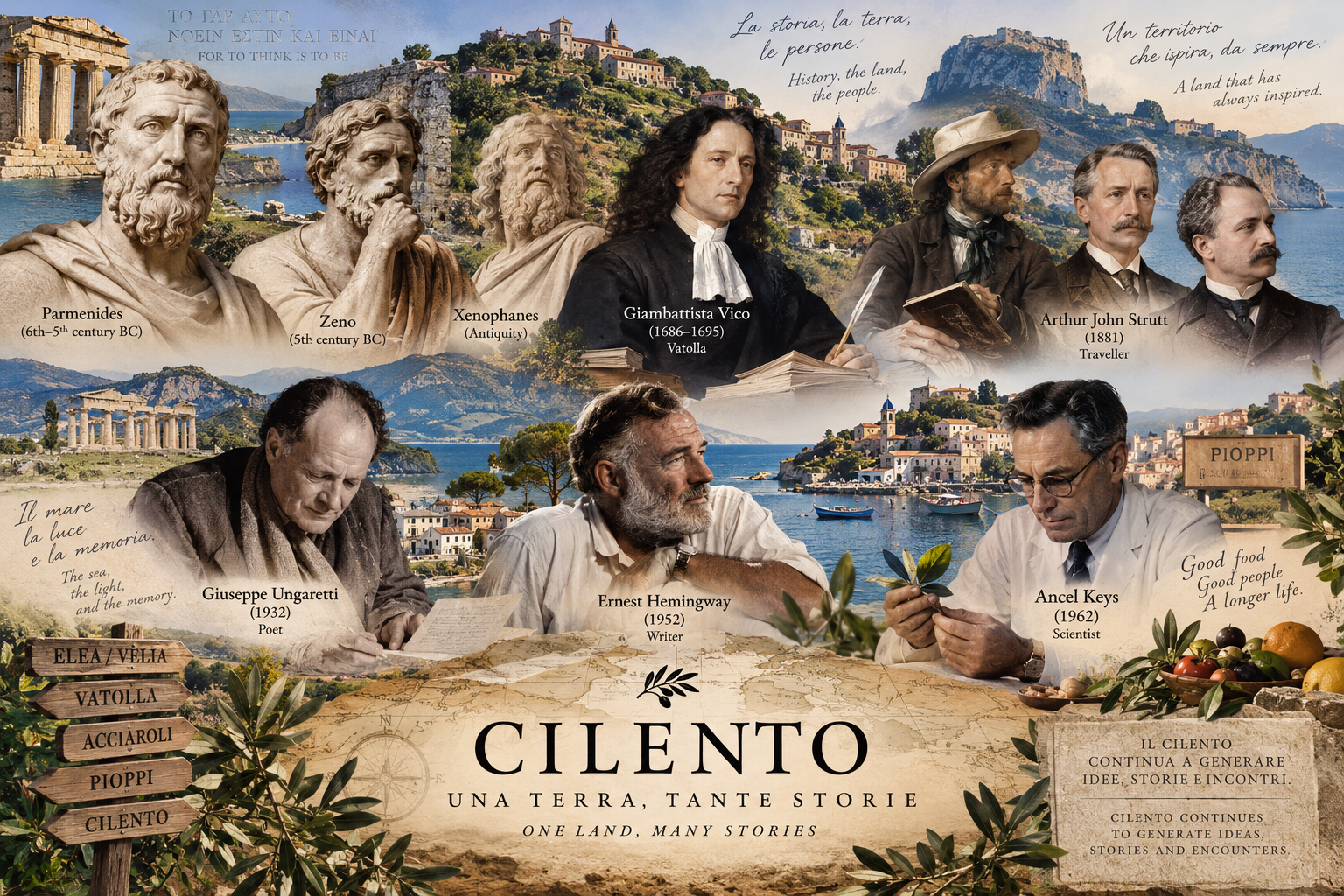
Philosophers, writers, scientists and travellers who left their mark
Cilento is not only a land of sea, mountains and ancient villages. Throughout the centuries, it has also been a land of philosophers, poets, scientists, artists and travellers — some born here, others who arrived from afar and were captivated by its landscapes, culture and way of life.
From Parmenides, who laid some of the foundations of Western thought in ancient Elea, to Ancel Keys, who studied the lifestyle of the people of Pioppi and helped bring the Mediterranean Diet to worldwide attention, Cilento has crossed paths with remarkable figures from very different worlds.
This is a journey through the centuries, following the people who helped make Cilento known far beyond its borders.
6th–5th century BC — Parmenides of Elea
Our journey can only begin with Parmenides, the most famous son of ancient Elea, today's Velia.
A philosopher who lived between the 6th and 5th centuries BC, Parmenides is regarded as the leading figure of the Eleatic School and one of the most influential thinkers in the history of Western philosophy.
In his poem On Nature, he explored the nature of Being and knowledge, developing ideas that would profoundly influence philosophy for centuries to come.
In Elea, Parmenides was not merely a philosopher: according to ancient tradition, he also played an important role in the political life of the city.
Today, his name remains inseparable from the archaeological landscape of Velia, where the memory of the ancient philosopher is still preserved.
His connection with Cilento: born and raised in ancient Elea, Parmenides represents one of the most important cultural figures in the history of the territory.
5th century BC — Zeno of Elea
Alongside Parmenides stands Zeno of Elea, his disciple and one of the most important representatives of the Eleatic School.
Born in Elea at the beginning of the 5th century BC, Zeno became famous for his celebrated paradoxes of motion and plurality, developed in defence of Parmenides' philosophical ideas.
His arguments, apparently simple yet extraordinarily complex, continued to fascinate philosophers and mathematicians for more than two thousand years.
Zeno is therefore one of the earliest figures connected to Cilento whose intellectual influence reached far beyond the Mediterranean world.
Antiquity — Xenophanes and the Eleatic tradition
Among the figures associated with the origins of the philosophical tradition of Elea is Xenophanes of Colophon.
Ancient tradition connects him with the foundation of the colony and the origins of the Eleatic philosophical tradition, although his precise role in the foundation of Elea and in the formation of the school remains debated.
His name nevertheless remains closely connected with the history of Elea and the development of one of the most important philosophical traditions of the ancient world.
17th century — Giambattista Vico in Vatolla
Many centuries after Parmenides, another great thinker found an important place for intellectual growth in Cilento.
His name was Giambattista Vico, one of the most important Italian philosophers of the modern age.
Between 1686 and 1695, Vico spent several years in Vatolla, today a hamlet of Perdifumo, where he worked as a tutor.
Far from the noise of Naples, the young philosopher devoted himself to the study of philosophy, history, classical literature and law.
His years in Cilento became an important period in his intellectual development.
Today, Vatolla still preserves the memory of Vico's stay and represents one of the most fascinating cultural destinations for visitors wishing to follow the footsteps of great thinkers through Cilento.
18th–19th centuries — Cilento through the eyes of travellers
During the modern age, and particularly between the 18th and 19th centuries, Cilento began to appear in the journeys of numerous European travellers, writers and scholars.
At the time, it was still far from the main routes of the Grand Tour. Yet this very distance made the territory particularly fascinating.
Among the most interesting figures were Craufurd Tait Ramage, a Scottish writer and traveller, and Arthur John Strutt, an English painter and traveller.
Strutt travelled through Cilento in 1838 during his journey through southern Italy, leaving descriptions of villages, landscapes, inhabitants and living conditions.
His account provides a valuable glimpse into 19th-century Cilento and the rural world he encountered.
These travellers helped introduce the landscapes and communities of Cilento to readers throughout Europe.
19th century — Cosimo De Giorgi
Another important observer of the territory was Cosimo De Giorgi, an Italian physician, geologist and scholar.
In 1881, he travelled through Cilento as part of a scientific expedition dedicated to the study of the area's geology.
His journey went far beyond geology. De Giorgi carefully observed villages, agriculture, roads, social conditions and everyday life.
His observations were later published in Da Salerno al Cilento, an important testimony to Cilento during the 19th century.
His work provides a fascinating opportunity to understand how the territory and its communities appeared more than a century ago.
1932 — Giuseppe Ungaretti
During the 20th century, Cilento continued to attract writers and intellectuals.
In 1932, Giuseppe Ungaretti travelled through the region during his journey through southern Italy.
The poet visited several important places in Cilento, including Paestum, Agropoli, Pioppi, Elea, Pisciotta and Punta Licosa.
His journey later became part of the writings collected in Il deserto e dopo, in the section dedicated to southern Italy.
In Elea, Ungaretti encountered the memory of the ancient philosophers; in Pioppi, he observed the landscape and the local people, impressed by the warmth and hospitality of the communities he encountered.
His writings remain among the most evocative literary testimonies of 20th-century Cilento.
20th century — Ernest Hemingway and Acciaroli
Ernest Hemingway is also associated with the recent history of Cilento.
According to local tradition, the American writer stayed in Acciaroli in 1952, during one of his journeys through Italy.
The connection between Hemingway and the small fishing village has become part of the local memory and contributes to Acciaroli's international appeal.
Whether through literature, travel or local storytelling, Hemingway's name has become part of the fascinating history of the relationship between Cilento and the outside world.
From 1962 — Ancel Keys and the Mediterranean Diet
Among all the personalities who came to Cilento during the 20th century, few had an impact as international as Ancel Keys.
An American physiologist and biologist, Keys arrived in Pioppi in 1962 with his wife, Margaret, and chose the small coastal village as a place to live, study and conduct research.
Here he investigated the dietary habits and lifestyle of local communities, studying their relationship with the relatively low incidence of cardiovascular disease.
His research contributed significantly to the international recognition of the Mediterranean Diet and helped transform Pioppi into one of the world's symbolic places for research into nutrition, lifestyle and health.
Keys remained deeply connected to Cilento for more than forty years. He named his home Minnelea, combining the name of his American city, Minneapolis, with Elea, the ancient name of Velia.
Other important researchers, including Finnish physiologist Martti Karvonen and American cardiologist Jeremiah Stamler, were also involved in the international studies that investigated cardiovascular health and lifestyle.
Today, the legacy of Keys remains one of the strongest links between Cilento and the international history of the Mediterranean Diet.
A land that continues to inspire
The story of the great figures connected with Cilento does not end with the names listed here.
Philosophers, scientists, writers, artists, travellers and researchers have continued to choose this land as a place of study, inspiration or simply discovery.
Perhaps this is one of Cilento's most fascinating qualities:
it is not simply a place to visit, but a land capable of leaving something behind in everyone who walks through it.
Parmenides found here a place to question the nature of Being.
Vico found the quiet needed for study.
Ungaretti found landscapes and people worthy of poetry.
Keys found a way of life that would eventually become part of a cultural heritage recognised throughout the world.
And today, from Velia to Pioppi, from Acciaroli to Vatolla and throughout the many villages of the inland area, Cilento continues to tell the stories of those who passed through it — and of those who chose to stay.
An ancient land, still capable of generating ideas, stories and encounters.