
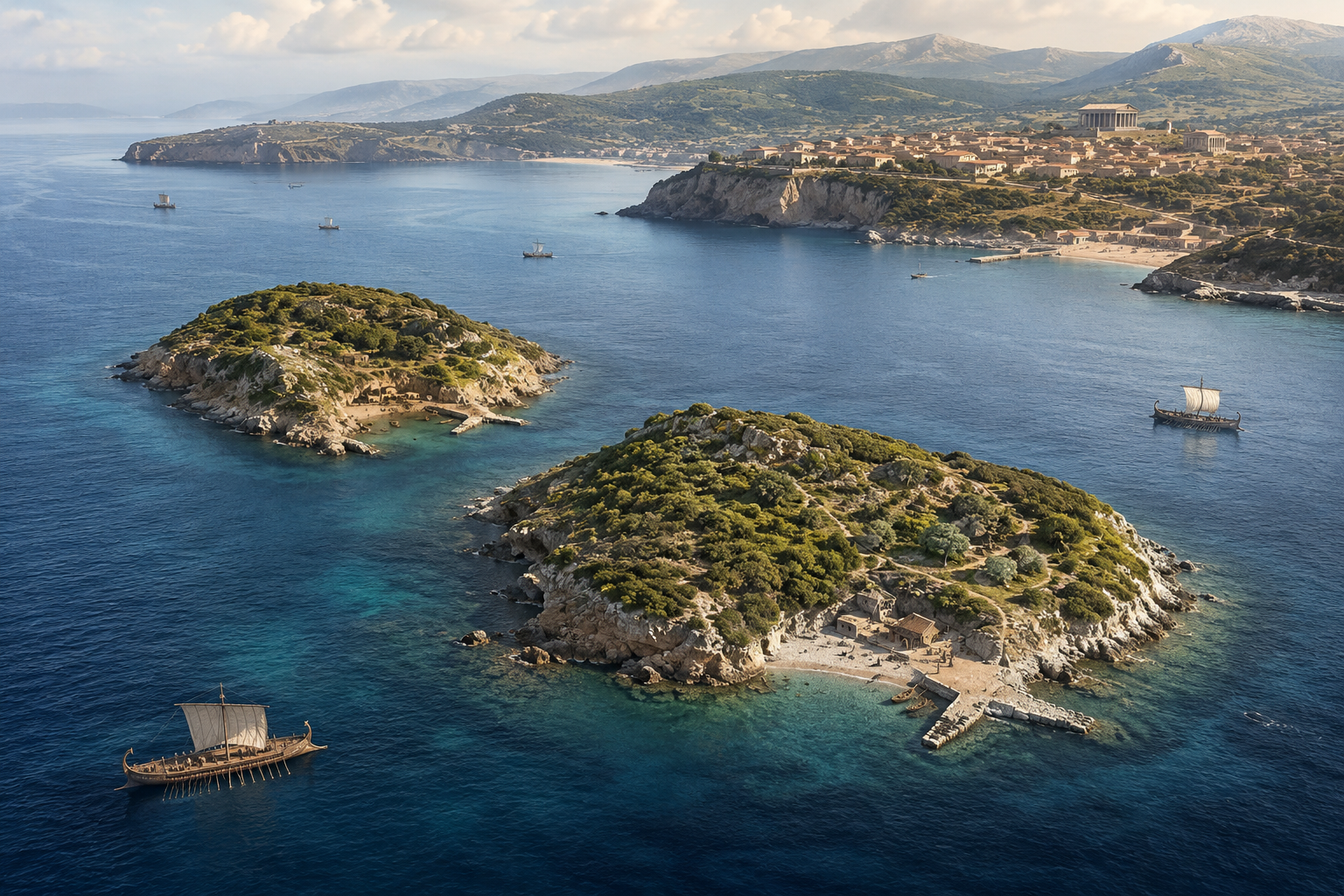
Among the most fascinating mysteries hidden beneath the waters of Cilento are the Enotridi, two ancient islands that have disappeared over time and were once described by classical authors as lying off the coast of Elea, now known as Velia.
Their existence is documented in important historical sources and remains one of the most intriguing enigmas of ancient Mediterranean geography.
The Enotridi in Ancient Sources
The earliest references to the Enotridi come from the Greek geographer Strabo, who, between the 1st century BC and the 1st century AD, described two small islands located between Elea and the promontory of Palinuro in Book VI of his Geography.
According to his account, both islands possessed natural harbors, suggesting that they may have served as stopping points for sailors navigating the commercial routes of Magna Graecia along the Tyrrhenian coast.
A few decades later, Pliny the Elder, in his famous Naturalis Historia, also mentioned these islands, preserving what were likely their names: Pontia and Isacia. However, ancient sources do not always agree, and scholars still debate their exact identification and location.
The Connection to the Enotrians
The islands were known collectively as the Enotridi, a name that recalls the Enotrians, one of the earliest peoples to inhabit southern Italy before the arrival of the Greek colonists.
For this reason, the Enotridi are more than a geographical curiosity; they represent an important link to the earliest history of the Cilento region, predating the foundation of Elea and the rise of Magna Graecia.
Where Were They Located?
The exact location of the Enotridi remains one of the great mysteries of local history.
Based on the descriptions left by ancient authors, the islands were situated off the coast between Velia and Palinuro. Today, however, no existing island can be identified with certainty as one of the Enotridi.
Researchers believe that the Cilento coastline looked very different in antiquity. Over the past two thousand years, the Mediterranean landscape has undergone significant changes caused by:
- Coastal and submarine erosion
- Landslides
- Earthquakes
- Sea-level fluctuations
- Geological movements of the seabed
These natural processes may have dramatically altered the coastline, eventually leading to the disappearance of the ancient islands.
Theories and Scientific Research
Over the centuries, scholars have proposed several theories regarding the nature of the Enotridi.
Some researchers suggest that they were small rocky islets or emerging reefs that served as navigational landmarks and temporary shelters for ancient sailors.
Others have proposed a volcanic origin. Modern marine geological studies have identified ancient submerged volcanic structures off Cape Palinuro, revealing the area's complex geological history.
To date, however, no definitive evidence has been found linking these underwater volcanic formations directly to the islands described by Strabo and Pliny.
A Mystery That Endures
Despite advances in archaeology, geology and marine research, the mystery of the Enotridi remains unsolved.
These lost islands continue to captivate historians, researchers and visitors alike, representing one of the many secrets still hidden beneath the waters of the Mediterranean.
A Legacy of History and Memory
The story of the Enotridi offers a glimpse into an ancient Cilento shaped by sailors, trade routes and cultural exchanges across the Mediterranean.
Although the islands have vanished from the modern landscape, they live on through the writings of classical authors and the historical memory of the region.
Somewhere between Velia and Palinuro, beneath the waters of the Tyrrhenian Sea, lies the enduring legacy of one of Cilento's most fascinating mysteries.